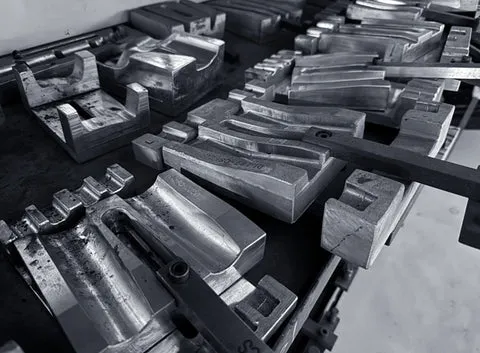
Upgrading your road, gravel, or triathlon setup with carbon aero bars is one of the most effective mechanical upgrades you can make to cut aerodynamic drag ($CdA$) and hold higher average speeds with fewer watts. Yet, before clipping into your pedals, almost every cyclist and custom bike builder confronts the exact same compatibility challenge:
“Will these clip-on aero bars actually fit my handlebars without slipping, wobbling, or crushing the carbon laminate?”
Modern bicycle cockpits are no longer uniform. Drop handlebars range from traditional $31.8\text{ mm}$ round profiles to proprietary teardrop flat tops, flared gravel shapes, and fully integrated aero one-piece bars. Choosing the wrong clamp profile or applying incorrect bolt torque can ruin a high-end carbon bar.
As an integrated carbon composite bicycle manufacturer with over a decade of OEM/ODM engineering experience, we engineered our modular clamp systems (Options A, B, and C) and multi-hole baseplate systems (D Version) to eliminate compatibility guesswork.
Here is everything you need to accurately measure your handlebars, select the correct mounting clamp, and safely install carbon clip-on aero bars and TT handlebars on your machine.

Handlebar Clamp Compatibility Matrix: Quick Reference
Before grabbing your hex keys, measure your bar profile where the mounts will sit. Match your handlebar geometry to our precision-machined clamp configurations below:
| Mounting Option | Target Handlebar Profile | Dimension Limits | Cockpit Requirement |
|---|---|---|---|
| Option A | Traditional Round Drop Bars | Diameter: 31.8 mm | Center cylindrical clamp zone > 70mm |
| Option B | Standard/Narrow Aero Wing Bars | Max Width: 41mm
Thickness: 20 – 25mm |
Twin-bracket aero clamp profile |
| Option C | Wide / Oversized Flat Wing Bars | Width: 41 – 45mm
Thickness: 18 – 30mm |
Adjustable hinged clamping bracket |
| D Version (Adapter) | Multi-Position Armrest Baseplate | Slotted multi-hole spacing grid | Fits bridge extensions, armrests & angled wedges |
Step 1: Accurate Handlebar Measurement (Width vs. Thickness)
Never eyeball or measure your handlebar cross-section with a soft tailor’s tape. Use digital or mechanical vernier calipers to take precise measurements at two critical zones:
- Center Clamping Width (Round Bars): Measure the clear cylindrical zone on either side of your stem faceplate.
- Wing Chord Width (W) & Thickness (T) (Aero Bars): Measure the cross-section roughly 40mm to 60mm away from the stem centerline where the clamp bands grip the tops.
Step 2: Selecting the Correct Mounting Clamp System
Select the clamp system that guarantees compatibility and safety for your handlebar. Matching the correct version to your bar shape prevents stress concentrations. Once identified, secure it using proper techniques and tension settings for a safe, durable connection.
Option A: Standard 31.8mm Round Handlebar Clamp
Designed for classic round alloy or carbon drop handlebars paired with a separate stem setup.
- Target Profile: Strict $31.8\text{ mm}$ circular clamping surface.
- Essential Requirement: Your handlebar must have an uninterrupted cylindrical clamping section of at least $70\text{ mm}$ in total width across the stem clamp zone. If the round tube tapers into an oval or flat profile too close to the stem faceplate, Option A will pinch the taper edge and cause localized stress concentrations.
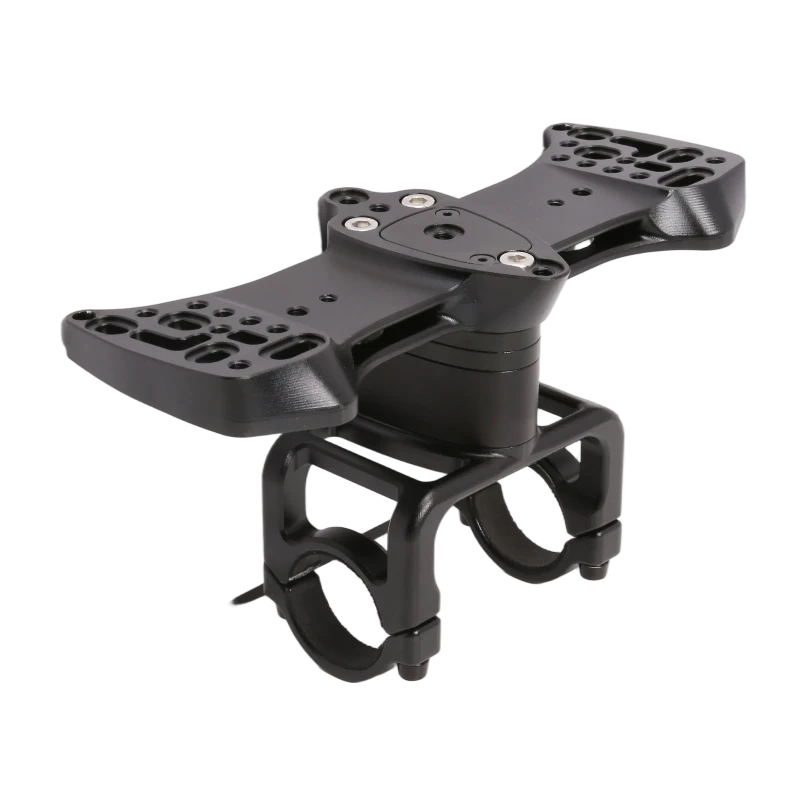
Option B: Dedicated Aero Wing Clamp (Compact Profile)
Engineered for aerodynamically contoured drop bars featuring moderate teardrop or ovalized wing tops.
- Compatibility: Aerofoil tops with a maximum width of 41mm and a thickness between 20mm and 25mm .
- Ideal Setup: Standard aero road handlebars where traditional circular clamps cannot seat flush.
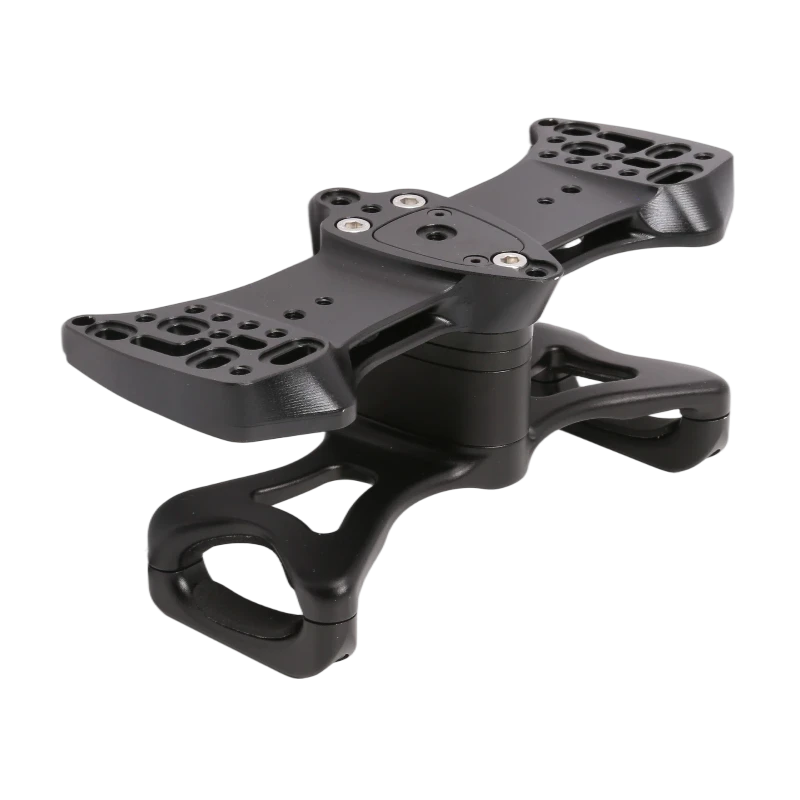
Option C: Adjustable Heavy-Duty Aero Clamp (Wide Profile)
Engineered for modern high-performance aero road cockpits featuring deeper chord dimensions, integrated flattened profiles, and internal routing channels.
- Compatibility: Accommodates wing widths between 41mm and 45mm , with an expanded thickness range from 18mm up to 30mm .
- Key Feature: The lower bracket features an articulated, multi-angle hinge mechanism that conforms evenly around complex, non-standard aero cross-sections without localized pressure spikes.

D Version: Multi-Hole Riser Baseplate System
The CNC-machined alloy D Version baseplates act as the structural bridge between your handlebar clamps and your upper forearm support cups.
- Reach & Stance Adjustability: Features longitudinal adjustment slots paired with a multi-hole threaded grid. This allows riders to independently dial in forward extension reach and arm-pad width.
- High-Hands Wedge Compatibility: Pairs directly with 10mm and 15mm angled spacer wedges to achieve an aggressive “praying mantis” high-hands posture that minimizes upper-body aerodynamic drag (CDA).

Step 3: Installation & Torque Guidelines (Without Crushing Carbon)
Carbon composite cockpits deliver incredible tensile strength, but localized crushing force from over-torqued alloy hardware will fracture the epoxy matrix. Follow these professional workshop steps:
1. Degrease & Apply Carbon Assembly Paste
Wipe down the clamping surface on the handlebar and the inner contact surface of the clamp brackets using isopropyl alcohol. Never mount carbon components dry. Apply a thin layer of carbon friction paste (assembly compound) to all contact interfaces. The suspended micro-beads increase friction by up to 30%, preventing component slippage at lower torque values.
2. Verify Internal & External Cable Routing Clearance
If your bike uses semi-internal routing or external hydraulic brake lines beneath the bar tape, ensure the lower clamp bands do not pinch or compress the lines against the underside of the handlebar.
3. Progressive, Cross-Pattern Torquing
- Hand-thread all bolts into the brackets until snug before applying mechanical load.
- Alternate between forward and rear bolts in 0.5Nm increments to keep the clamping gaps perfectly parallel on both sides.
- Strict Torque Values: Use a calibrated torque wrench. Do not exceed 4 – 5 Nm on the primary handlebar clamp bolts (or consult the maximum torque rating stamped on your handlebar). Baseplate mounting bolts should be secured to 5Nm with medium-strength threadlocker (Loctite 242/243).
Frequently Asked Questions (FAQ)
Can I install clip-on aero bars on lightweight carbon handlebars?
Only if your handlebar manufacturer explicitly certifies the model for clip-on clamps. Ultra-lightweight carbon climbing bars often have ultra-thin wall layups on the top section that cannot handle radial clamping pressures or rider weight transfer over bumpy roads. Reinforced or aero-specific carbon handlebars are required.
What should I do if my aero bar width measures exactly 41mm?
If your bar width sits on the threshold between Option B (41mm max) and Option C (41 – 45mm), inspect the thickness. If your bar is thinner than 20mm or thicker than 25mm, choose Option C. Its adjustable bracket provides an expanded clamping thickness range of 18 – 30mm, ensuring secure engagement.
Why do my TT handlebar extensions creak under power?
Creaking almost always indicates dry interfaces or uneven bolt tension. Disassemble the mounts, wipe away old debris, reapply fresh carbon grip paste to all clamp interfaces, and re-torque the bolts evenly in a cross pattern to the specified torque limit.
Factory-Direct Carbon Cockpits: OEM & Wholesale Supply
Haidelibikes is a specialized carbon fiber bicycle frame and component manufacturer with over a decade of precision tooling, engineering, and OEM/ODM mass-production experience.
Whether you are an international brand launching a private-label aero bar line or a distributor looking for bulk TT handlebar clamp hardware engineered to exact dimensional tolerances, our engineering team provides complete support from CAD tooling design to ISO fatigue testing. Contact our technical sales team at haidelibikes.com to discuss bulk supply, custom clamp tooling, and private-label carbon projects.