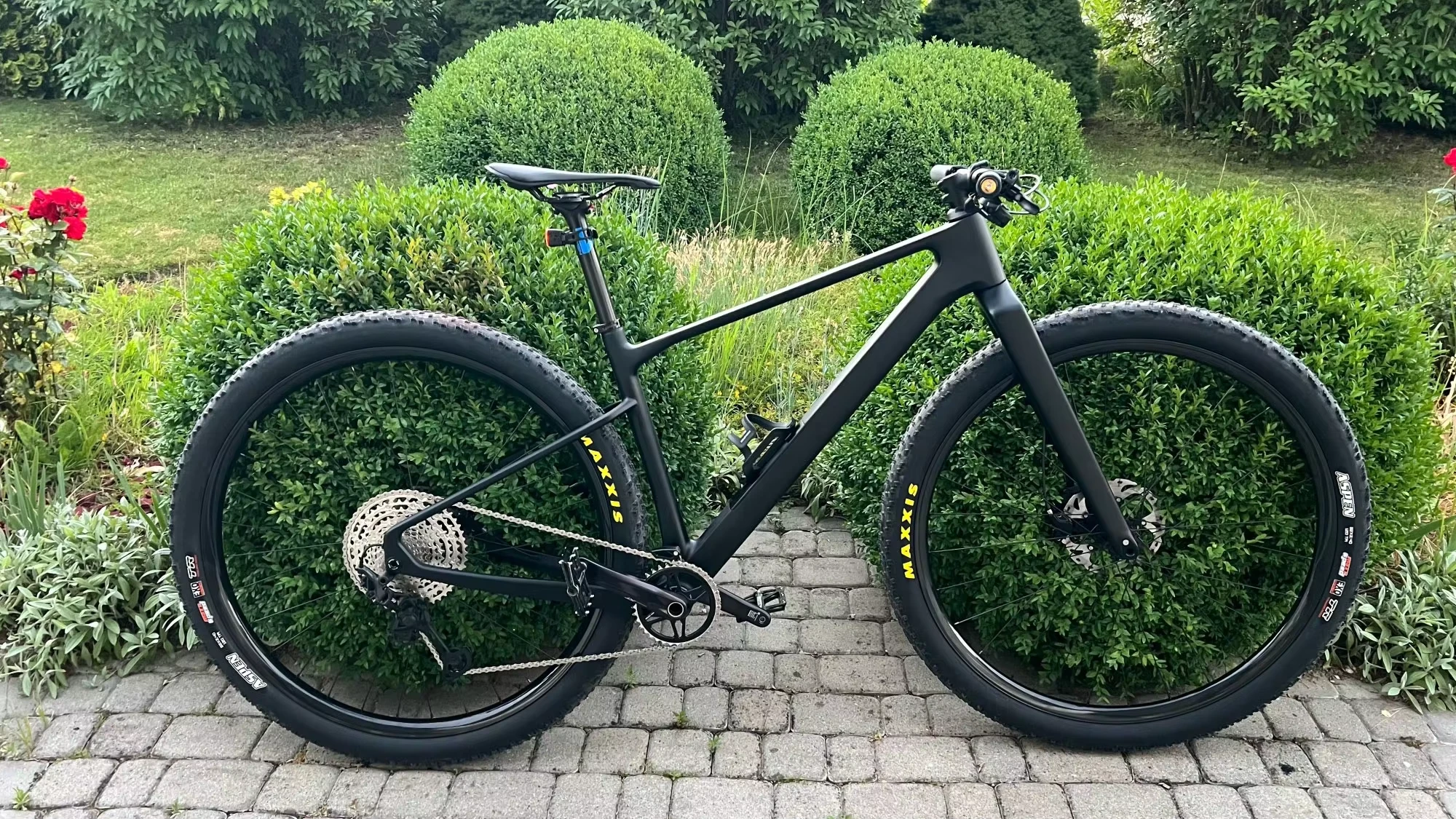
So, you’ve taken the plunge into the absolute vanguard of mountain bike wheel sizes and picked up a 32er MTB frame. Congratulations, you are officially an early adopter. You’re ready to monster-truck over everything, carry momentum like a freight train, and question why we ever rode 26-inch wheels.
But then you hit the wall: sourcing hardware. Specifically, finding a legitimate, high-performance suspension fork native to the 32-inch standard. The options are… let’s just say, “limited.” If you browse the Reddit threads or forums, you’ll see the inevitable query pop up: “Can I just run a high-end 29er boost fork on my 32er hardtail frame, or is that a geometry death wish?”
The prevailing wisdom from the keyboard warriors is usually, “No, it’ll ruin the handling.”
As a carbon fiber bike parts manufacturer with over ten years of engineering, mold-making, and trade experience, I’m here to tell you: The “consensus” is wrong. Not only is running a 29er boost fork on a 32er hardtail MTB frame possible, but for a specific type of performance-focused rider, it’s actually a legitimate XC race hack.
Yes, it works. Here is the technical breakdown of why and how to do it right.
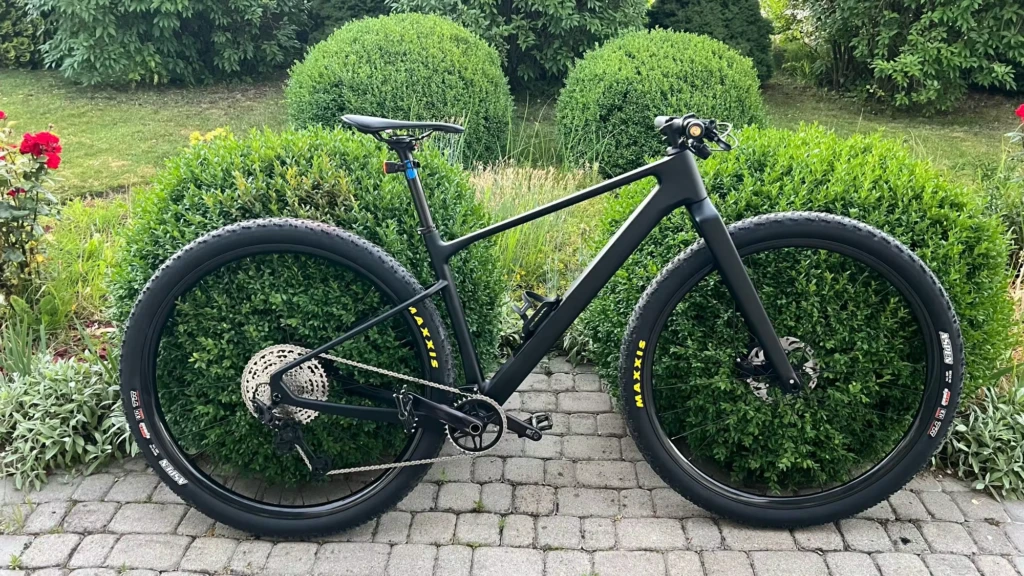
The Early Adopter Problem: The 32er Components Drought
Let’s be real for a second. The 32er MTB niche is where the 29er movement was fifteen years ago. The potential for endurance performance benefits is massive—insane rollover capabilities, a smoother ride, and unparalleled traction due to the massive contact patch. It’s the ultimate expression of momentum-based riding.
However, the supply chain hasn’t caught up with the frame concept. Finding a carbon fiber bike parts manufacturer churning out dedicated 32-inch suspension forks at a wholesale level is tough. When you do find them, they are often heavy, lack sophisticated dampers, or have limited custom fork layup options for tuning stiffness.
This is what drives riders to look at their high-end 29er boost forks sitting in the garage. They have the damper you love, the lightweight carbon fiber structure (if applicable), and they are readily available.
But is the switch purely a compromise of necessity, or is there a performance upside? To answer that, we have to talk about the boogeyman of bike building: Geometry Effects.
The Critical Engineering Metric: Axle-to-Crown (ATC) and
When you change a fork native to one wheel size to a different wheel size, you are not just swapping parts; you are redefining the bike’s steering axis.
The most critical measurement here is Axle-to-Crown (ATC) height.
A native 32-inch rigid or short-travel fork is designed with a specific ATC to keep the hardtail MTB frame‘s geometry—specifically the headtube angle (HTA) and bottom bracket (BB) height—at their engineered set points.
A 29er boost fork is significantly shorter in its native state than a 32er fork. If you do a straight swap, you will steeply steepen the head angle and drop the bottom bracket to pedal-strike territory.
1: Geometry Effects and How to Counteract Them
To make a 29er boost fork work on a 32er MTB frame, you have to use suspension travel as a bike geometry correction tool.
Think of it this way: to maintain the same Axle-to-Crown height as a 32er fork while using a 29er fork, you need to use a 29er fork with significantly more travel.
-
Scenario A (Native): 32er Rigid Fork ATC.
-
Scenario B (The Hack): 29er Boost Fork (140mm Travel) ATC.
By choosing a longer-travel 29er boost fork, you “lift” the front end of the 32er frame back to near its original engineered position.
Table: 32er Hardtail Geometry Shift – Native Fork vs. 29er Fork Hack
| Fork Setup Scenario | Fork Travel | Axle-to-Crown (ATC) (Approx.) | Headtube Angle (HTA) Effect | Bottom Bracket (BB) Height Effect | Ride Characteristic |
| Native 32er Rigid (Baseline) | 0 mm | ≈510mm | Engineered (e.g., 69°) | Engineered Setpoint | Momentum-focused, ultra-responsive |
| Native 32er Sus. (Rare) | 100 mm | ≈ 540 mm | Slacker (e.g., 75°) | Slightly Higher | Trail-friendly, monster-trucking |
| 29er Fork Hack (Wrong Way) | 100 mm | ≈510 mm | CRITICAL STEEPENING (e.g., 72°) | TOO LOW (Pedal Strikes) | Unstable, dangerous handling |
| 29er Fork Hack (XC Race Hack) | 140 mm | ≈550 mm | Efficient (e.g., 68°) | Balanced (Cruising) | Optimal climbing, anti-fatigue |
2: The Hidden Performance Hack: Aggressive and Traction
Now, here is where the “XC race hack” comes in.
If you are building a 32er hardtail MTB frame, you are likely focused on endurance, gravel-grinding, or non-technical XC racing where momentum is king. You don’t need 140mm of travel for those disciplines.
However, running a 130mm or 140mm 29er boost fork gives you two things native 32er rigid forks don’t:
-
Plushness and Dampening: Sophisticated modern dampers to manage hand fatigue over long distances.
-
Tunable Geometry for Efficiency:
The geometry effects of this setup actually lean toward efficiency. Because the ATC is slightly corrected but not perfectly matched, the headtube angle remains slightly steeper than a lazy trail geometry. This places the rider in a more efficient climbing position.
Furthermore, by reducing the frontal wind area—even slightly—due to the lower overall stack height compared to a fully rigid 32er setup, you get a micro-reduction in your CdA (Coefficient of Drag). Over a 100km race, that matters.
Technical Feasibility: The “Why It Actually Fits” Section
We’ve established the why (geometry correction and part availability). Now, let’s talk about the physical how. This is where the Reddit threads get really confusing.
1: Why Hub Spacing (Boost) is Non-Negotiable
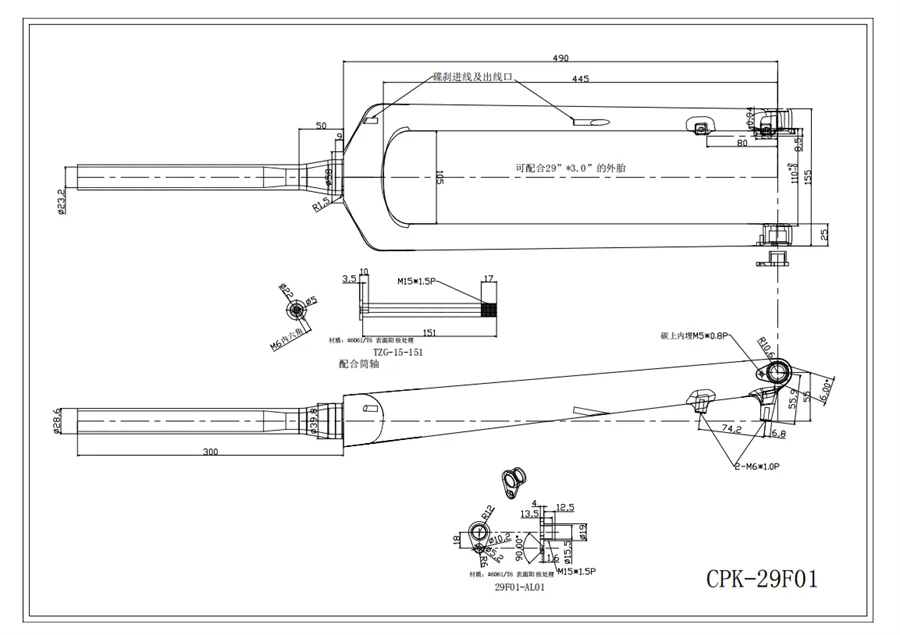
You cannot run a standard non-boost 29er fork. It must be a 29er boost fork (110x15mm spacing).
Why? It’s not about the hub; it’s about arch clearance. A 32-inch wheel is not just taller; it is significantly wider at the midpoint. You need the wider stance of boost spacing between the fork lowers to provide enough lateral room for the 32-inch tire, even a narrow XC casing.
Without boost spacing, the sidewall of your tire will likely rub the inner fork legs under load, which is a recipe for catastrophic failure.
2: The 32er Mullet? Axle, Pad, and Tire Spacing
This setup is the ultimately “cockpit aerodynamics” upgrade for the front triangle, and we call it the “32er Mullet Fork.” It’s clean, integrated, and technically sound if you measure the following three points:
-
Crown Clearance at Full Compression: This is the big one. When your suspension bottoms out, the top of the 32-inch tire must not contact the bottom of the fork crown. This is where using a 29er fork with too little travel fails. By using a longer-travel fork (e.g., 140mm) but only needing 100mm of active travel for XC, you create a “safety margin” of ATC height that prevents bottom-out contact. Always test this by deflating the fork and checking for contact.
-
Lower Arch Clearance: The tire must pass cleanly under the fork lower arch. Boost spacing handles the width, but you need to check the radial clearance. If you are running an aggressive, high-volume 32er tire, this might get tight. Stick to XC-tread patterns to maximize space.
-
Brake Caliper Alignment: Brake mounts (Post Mount 160 or 180) are standard across wheel sizes. Your 32-inch wheel with its designated rotor size will bolt right onto the 29er boost fork brake mounts without issue.
B2B Insight: Manufacturing and Sourcing the 32er Cockpit
If you are a bicycle brand, distributor, or a private label aero bars manufacturer looking to expand into frames, this 32er frame concept is where the market is moving for endurance.
From an OEM carbon bike parts manufacturer perspective, we support this setup because it stabilizes the platform. When a customer knows they can source a reliable 29er boost fork to make their 32er frame work, the purchase decision for the frame becomes significantly easier.
We focus our bike frame mold design to account for this possibility. This means:
-
Optimal Strength-to-Weight Ratio: The headtube junctions are reinforced not just for the leverage of a rigid fork, but for the complex loads of a 140mm travel suspension fork.
-
Carbon Assembly Paste Compatibility: The tolerances on our headtubes are precise, intended to be used with high-quality headsets and assembly paste to prevent creaking under these varied load profiles.
-
Custom Layup Schedules: For B2B clients, we can tune the carbon laminate schedules around the headtube to be stiffer laterally if they intend to market the frame around suspension fork use, or more compliant if they plan for rigid-only use.
Supporting this setup stabilizes aero road bike cockpit upgrade opportunities, it stabilizes frame sales, and it gives the rider an easier entry point into the discipline.
Installation Checklist & Best Practices (The Right Way to DIY)
If you are a rider looking to execute this “Crazy Setup,” do not just bolt it on and rip. Follow this manufacturer’s workshop protocol.
1: Step-by-Step Fitment of a 29er Fork on a 32er Frame
-
Source the Right Fork: Buy a 29er boost fork with at least 130mm of travel, preferably 140mm or 150mm if your terrain is rough. Damper quality matters more than travel here.
-
Measure ATC: Check the Axle-to-Crown height of your intended 29er fork. Compare it to the native requirement of your 32er MTB frame.
-
The Crown Clearance Test (CRITICAL):
-
Mount the fork to the frame using a headset (check for proper stack and reach positioning).
-
Install your 32-inch front wheel with the intended tire fully inflated.
-
REMOVE ALL AIR from the suspension fork.
-
Slowly compress the fork until it completely bottoms out (metal-on-metal or elastomer bump).
-
Verify at least 10mm of clearance between the top of the tire and the bottom of the fork crown. If it touches, DO NOT RIDE IT.
-
-
Use Carbon Assembly Paste: When pressing in headset cups and installing the stem, use high-quality carbon assembly paste. The different geometry will introduce new torque loads, and paste increases friction without over-torquing the bolts.
-
Use a Torque Wrench (Nm): This is non-negotiable for carbon MTB parts. Over-torquing the stem on the carbon steerer, or the fork lowers on a carbon crown, can cause catastrophic failure. Follow the manufacturer’s torque specs (usually 5–7 Nm).
2: Suspension Tuning for the Larger Wheel Size
A 32-inch wheel has significantly more rotational inertia and leverage than a 29er wheel. When you brake, accelerate, or corner, that wheel is putting different forces into the fork lowers.
-
Increase Dampening: You will likely need to increase both low-speed compression and rebound dampening compared to how you would set up the same fork with a 29er wheel. The heavier wheel wants to keep compressing and wants to snap back faster.
-
Air Pressure: You may need to run slightly higher air pressure to counteract the increased leverage of the larger wheel.
Aero Road Bike Cockpit Upgrade: The 32er Perspective
Wait, did we just say aero road bike cockpit upgrade in an MTB article?
Yes, because the principles are converging. Modern endurance MTB riding—gravel-plus, bikepacking, and non-technical XC—is increasingly about sustained, long-distance speed.
By optimizing the 32er hardtail MTB frame with a sophisticated 29er boost fork, you are applying road-world logic (better dampers for less fatigue, slightly more aggressive posture for efficiency) to the off-road space.
As a carbon fiber bike parts manufacturer, we view the front triangle as an integrated system. The choice of tt handlebar, the cable integration, and the choice of fork native or otherwise, all contribute to how the bike manages drag and manages rider fatigue. Running the 29er fork setup is part of this “integrated systems” approach to optimizing performance, not just compatibility.
Final Verdict: Race Hack or Crazy Compromise?
So, is running a 29er boost fork on a 32er hardtail MTB frame a crazy setup?
If you try to bolt on a 100mm 29er fork to a frame built for a 160mm 32er fork (which don’t exist yet anyway), yes, that is crazy. You will crash, and you will hate it.
However, if you are a performance-focused rider using a hardtail MTB frame for endurance racing, and you use a 140mm+ 29er boost fork to correct the geometry?
It is absolutely an XC race hack.
It provides:
-
A plush, race-tuned damper native forks lack.
-
A lighter, high-performance carbon option.
-
The ideal geometry effects for sustained climbing efficiency.
-
Massive savings in time and availability.
Don’t let the Reddit “consensus” hold you back from building the ultimate endurance momentum machine. The math works, the engineering fits, and the performance gains are real. As a manufacturer that has been supporting innovative builds for over ten years, we say: Yes, it works. Now go build it.
FAQ – Carbon 32er MTB Frames & 29er Fork Hack
Q: Are standard 32er forks legal in XC racing? A: Yes. Most XC and endurance categories have rules based on suspension travel or overall bike geometry, not specific wheel size limits. The 32er setup with a 29er fork is fully competitive in endurance stages.
Q: Does using a 29er fork with more travel affect climbing efficiency? A: Yes, but in a good way for XC. By using longer travel, you correct the ATC height to near normal, maintaining an efficient headtube angle that prevents the bike from feeling sluggish on steep climbs.
Q: How do the geometry effects of this setup manage drag? A: Because the stack height is slightly lower overall than a comparable rigid 32er fork setup, you achieve a micro-reduction in (frontal wind area), which translates to sustained speed efficiency over long races.
Q: Where can I source bulk 32er MTB frames and compatible forks? A: We are a carbon fiber bike parts manufacturer specializing in custom carbon frame development and OEM production. We provide tailored solutions for 32er frame development and compatible fork sourcing.