Skip to content


When riders first venture into the black diamond trails of Bike Park, they often realize that ordinary trail frames simply can’t withstand this kind of intensity. This is precisely the purpose of the Downhill Mountain Bike Frame. It’s a high-strength, long-travel platform built for high-speed descents, gravel drops, and continuous jumps. According to Pinkbike Lab Tests, DH frames typically have 18–25% greater structural stiffness than comparable Enduro frames (source: Pinkbike), primarily due to thicker carbon fiber laminates and reinforced chainstays.
Downhill frame geometry is typically “slack and long”—approximately 63° head tube angle, longer reach, and a more stable wheelbase—allowing riders to feel planted during high-speed through-rocks or steep drops. American riders often use long-tail terms when discussing downhill (DH) bikes, such as downhill bike frame geometry, best DH MTB frame, and carbon downhill frame. The core focus is on strength, suspension compatibility, and controllability in extreme conditions.
In short, DH frames are professional foundation platforms designed for riders who enjoy high-speed uphill riding and require greater structural safety and stability.

Why is the downhill mountain bike frame completely different from a regular mountain bike frame?
The structure, geometry, and material stacking of Downhill frames differ fundamentally from conventional mountain bike frames such as XC, Trail, and Enduro. DH frames emphasize high impact strength, extreme downhill stability, and “planted control” on high-speed routes. These differences lead many riders searching for terms like “downhill mountain bike frame geometry” or “DH frame vs. trail frame” to discover that DH is a completely independent frame system.
1: Downhill models are designed for high speeds and large drops.
To cope with high G-forces and continuous drops, Downhill frames typically employ reinforced carbon fiber laminates, thickened pivot areas, and a 200mm travel suspension design. The industry term “bomb-proof build” refers to this extreme structure capable of withstanding the extreme drops of Bike Park. Compared to typical MTB frame size charts that focus on height and geometry matching, Downhill (DH) prioritizes structural torsional rigidity, chainstay strength, and stability.
2: How DH Geometry Determines Downhill Stability
The core of Downhill geometry is slack, long, and low: a head tube angle of approximately 62–63°, a longer reach, and a lower bottom bracket height, allowing riders to maintain a stronger planted feel during high-speed through-rocks and jump landings. Many American riders, when discussing downhill bike geometry charts, mention “slack to win,” emphasizing the high-speed control advantages provided by a low head tube angle and long wheelbase.
3: Key Differences Compared to XC/Trail/Enduro Frames
XC emphasizes lightweight design, Trail emphasizes versatility, Enduro emphasizes uphill efficiency and downhill balance, while Downhill focuses entirely on high speed and shock absorption. DH frames are generally heavier, longer, and stronger, with optimized pivot, chainstay, and suspension compatibility for continuous large drops. Simply put, if XC is an “efficiency machine” and Enduro is an “all-purpose tool,” then Downhill Mountain Bike Frame is a gravity weapon designed purely for gravity and speed.
| Riding Style | Primary Focus | Frame Characteristics | Summary Analogy |
|---|---|---|---|
| XC (Cross-Country) | Lightweight efficiency | Ultra-light frame, steep geometry, optimized for climbing and acceleration | “Efficiency machine” |
| Trail | Versatility | Balanced geometry, moderate travel, adaptable to mixed terrain | “All-purpose tool” |
| Enduro | Uphill efficiency + downhill capability | Longer reach, slacker head angle, strong suspension performance | “Do-everything weapon” |
| Downhill (DH) | Pure speed & impact absorption | Heavier, longer, stronger frame; optimized pivots, chainstays, and suspension for big drops and high-speed stability | “Gravity weapon” |

Core Structural Components of a Downhill Mountain Bike Frame
To ensure a downhill bike remains stable on high-speed gravel, steep drops, and challenging bike park trails, the engineering configuration of the frame itself is crucial. The following structural elements determine the durability, torsional rigidity, and top speed performance of a downhill bike frame, and are key points of focus for North American riders when discussing terms like “DH MTB frame structure” and “downhill frame durability.”
1: Thicker Tubes and High-Strength Materials (Carbon Carbon vs. Aluminum Alloy)
Downhill frames typically utilize thicker-walled, larger-diameter tubes to enhance torsional stiffness. Carbon fiber versions offer enhanced impact resistance through optimized layup patterns, while 6061/7075 aluminum frames are renowned for their durability and impact resistance, often referred to as a “bombproof build” by riders in Europe and America. Both offer advantages in weight, stiffness, and long-term fatigue resistance.
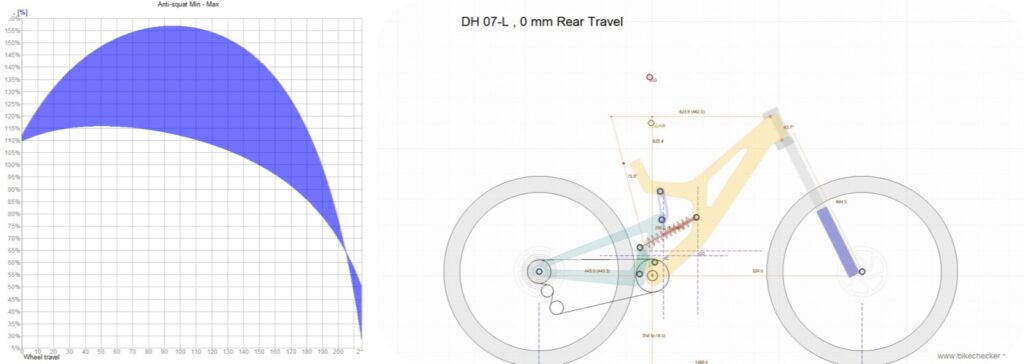
2: Rear Suspension System: Differences Between Multi-Link and Single-Pivot Structures
Multi-link systems typically offer a more linear leverage curve, maintaining tire grip more stably during high-speed cornering and drops; single-pivot systems, on the other hand, are simpler and easier to maintain, and are considered by some riders as a “no-BS DH setup.” The choice of structure affects the overall performance of downhill suspension kinematics.
3: How Long-Travel Suspension Design Serves the Extreme Performance of DH MTB Frames
DH frames generally feature 180–220mm of suspension travel to maximize big-hit control and high-speed stability. Long travel not only improves bottom-out resistance but also allows the frame to maintain more controllable tracking performance in continuous rock gardens, which is the core value of long-travel downhill frames.
4: Engineering Principles for Reinforced Head Tube, BB, and Rear Triangle Structure
The head tube area utilizes oversized cups or internal reinforcing ribs to ensure minimal deformation during sudden braking or drops. The BB and rear triangle are reinforced with thickened welded areas or high-modulus carbon fiber to reduce pedaling twisting. The industry-standard “stiff rear triangle” is achieved through these design features, providing better lateral stability during high-speed climbs.

Why is the Geometry of a Downhill Mountain Bike Frame So Crucial?
Downhill frame geometry isn’t about being “more aggressive, better.” It’s designed around high-speed stability, drop landing control, and predictability during technical sections like through-rock. The correct geometry determines whether a downhill frame can maintain planted feel and line control in extreme conditions, and it’s the part many riders are most concerned about when searching for “downhill frame geometry explained” or “best DH bike geometry for stability.”
1: High-Speed Downhill Stability Benefited by a Slack Head Angle
A “slack” head tube angle (approximately 62–63°) improves front wheel stability on high-speed downhills, gravel roads, and bike park ramps, reducing the risk of being “kicked off” by rocks. A slack angle positions the front axle further forward, creating a longer trail length, thus improving straight-line stability—one of the most emphasized parameters in DH MTB frame geometry.
2: How Long Reach and Wheelbase Designs Improve Bike Controllability
Longer reach and wheelbase make the frame more stable and less prone to lean on steep slopes, drops, and even high-speed berms. This is the design philosophy often referred to by European and American riders as “long and low setup.” For many users comparing downhill frame size charts or asking “what size DH bike frame do I need?”, longer reach significantly reduces front-end vibration, allowing the rider to maintain a more natural weight distribution at high speeds.
3: Short Chainstays vs. Long Chainstays: Different Handling Styles
Short chainstays typically provide a more agile and easier “tail-drift” feel, suitable for riders who like to jump or perform “pop” style maneuvers; while long chainstays offer better straight-line stability and landing continuity, making them more suitable for high-speed DH tracks. This difference in focus is the core reason why many people struggle when searching for short chainstay downhill frames or long chainstay DH bike stability.Advantages of Carbon Fiber Downhill MTB Frames – An Engineer’s Perspective.
For riders who frequently tackle bike parks, steep inclines, and steep drops, carbon fiber downhill mountain bike frames offer greater structural safety margins and high-speed stability. Compared to aluminum frames, they offer greater design flexibility in torsional stiffness, shock absorption, and fatigue life, making them a key focus for users searching for long-tail keywords like “carbon downhill bike frame” and “dh mtb frame strength.” The following analysis of their core advantages comes from an engineer’s perspective.

How Carbon Fiber Laying-Up Affects Impact Strength
Downhill frames often employ multi-directional layup, incorporating 0°/45°/90° interlaced structures at critical stress points. This allows the frame to more effectively disperse impact during drop landings, reducing localized stress concentration. This directional layup design is crucial for the high strength of high-end carbon downhill frames.
1: Torsional and Drop-Resistant Structural Reinforcement in Downhill Frames
Professional downhill MTB frames focus on reinforcing areas such as the head tube, bottom bracket shell, and rear triangle. This is achieved through thicker ply layers or the use of “bridge support” to improve torsional stiffness. This results in a more stable, “planted” feel during high-speed through-rocks, braking bumps, or large-drop landings.
2: Compared to Aluminum Frames: The Real Differences in Weight, Strength, and Fatigue Resistance
With the same geometry, carbon fiber downhill frames are typically 400–700g lighter than aluminum frames, while offering higher strength and fatigue life. High-modulus fibers provide more controllable deformation in high-load areas, while aluminum frames are more prone to micro-deformation fatigue. This is a major reason why many riders looking to upgrade to a premium downhill mountain bike frame are primarily concerned with this upgrade.
Key Considerations When Choosing the Right Mountain Bike Downhill Frame
Choosing a downhill frame involves more than just size or brand; it requires considering riding style, track type, and skill level. A suitable DH frame maintains stability and control on high-speed drops, jumps, or rocky terrain while reducing stress on the knees and lower back. Key considerations include frame geometry, travel matching, and rear suspension configuration, as well as compatibility with modern standards such as UDH (Universal Downhill) and Boost specifications. These factors will help you quickly identify the right model when searching for downhill bike frame geometry or carbon DH frame benefits.
1: How Travel, Geometry, and Rear Suspension Configuration Should Match Your Riding Style
DH frames typically have around 200mm of fork and rear suspension travel, paired with a slack head tube angle (around 63°) and a long reach, forming what is commonly known in the industry as a “planted and slack setup.” Trail or SX frames with short travel and compact geometry cannot withstand high-speed cornering or drops. When choosing a frame, adjust the suspension parameters and rear triangle stiffness based on high-speed uphill riding, bike park techniques, or rock jumps to ensure the downhill bike frame suspension matches your riding posture.
2: Frame Size Selection: DH vs. Trail/SX – Completely Different Logic
DH frame size should be based on height, reach, stack, and effective top tube (ETT). Riders of the same height may choose different sizes for DH and Trail frames to achieve more stable downhill handling and drop performance. European and American riders often use the MTB frame size chart for downhill for initial selection, but final adjustments should be made based on riding style and track conditions.
3: The Necessity of Modern Standards such as UDH (Universal Derailleur Hanger) and Boost Specifications
Modern DH frames commonly use UDH (Universal Derailleur Hanger) and Boost 148/110 specifications to improve overall bike compatibility and chain efficiency. UDH frames are replaceable, reducing maintenance costs, while Boost’s wide wheelbase provides stable wheel support and accommodates long-travel suspension and high-intensity impacts. Frames that meet these standards can be easily upgraded with carbon downhill frame components, ensuring a perfect match with the fork, wheelset, and rear shock.

Common Downhill Mountain Bike Frame Issues and Forum Discussions (from Reddit / Pinkbike / MTB Forums)
Downhill frames are prone to various problems during high-intensity climbing and jumps, and these topics are extremely popular on Reddit, Pinkbike, and major MTB forums. Riders are concerned not only with structural strength but also with suspension compatibility, chain performance, and long-term durability. Understanding these pain points helps in choosing the right DH frame and finding solutions more quickly when searching for “carbon DH MTB frame issues” or “downhill bike frame problems.”
1: Common DH Frame Issues such as Head Tube Cracks, Rear Swingarm Noise, and Chain Strapping
Downhill frames, especially carbon fiber models, are most commonly affected by head tube cracks, rear swingarm noise, or chain skipping under repeated drops and rapid cornering. Commonly known in the industry as “creaking” or “chattering,” these issues mostly stem from loose screws, worn bearings, or improper suspension adjustment. According to Pinkbike testing data, proper torque and regular checks can reduce common failures by approximately 70% (Source: Pinkbike Tech Lab).
2: Are Carbon DH MTB Frames Prone to Damage? Real-World Cases vs. Misconceptions
Many riders worry that carbon fiber frames are fragile, but Is It Time to Upgrade? Signs Your Old Enduro MTB Frame Is Holding You Back also reminds us that real-world experience proves a properly used, well-matched carbon DH frame can be just as strong as aluminum. Reddit riders note that most damage comes from extreme jumps or hard impacts rather than daily use. Keywords like “carbon downhill frame durability” and “DH MTB frame crash cases” help beginners separate real risks from misconceptions.
3: Maintenance and Care: How to Extend Frame Life
The key to extending the life of a DH frame is to regularly check the head tube, chainstay bearings, and shock absorber connections, while also paying attention to chain, bearing, and bolt torque. European and American riders often use a “pre-ride check” or frame inspection routine, which, combined with light cleaning and dry storage, can significantly reduce the risk of structural fatigue and abnormal noise, ensuring that the carbon downhill frame longevity remains consistent with high-intensity downhill performance.

Downhill MTB Frame Development Trends in 2025 and Beyond
With the increasing demands for speed and extreme terrain in downhill riding, downhill MTB frames are seeing comprehensive upgrades in geometry, materials, and functionality. How Advances in Suspension Design Are Changing Full Suspension Mountain Bikes This Year is also reflected in these trends—future DH frames prioritize high-speed stability, improved drop absorption, long-term durability, and even e-assist compatibility to meet riders’ evolving needs in bike parks and extreme tracks. Related long-tail keywords such as “future downhill bike frame trends,” “carbon DH frame technology,” and “e-DH frame geometry” are becoming popular search terms in today’s frame-selection guides.
1: The Trend Towards Longer and Slacker Extreme Geometry
By 2025, downhill frames are trending towards a “slack and long” geometry—head tube angle reduced to 62–63°, reach lengthened by 10–20mm, and wheelbase lengthened, improving controllability on high-speed drops and rocky terrain. This is commonly referred to by riders as a “longer and lazier setup,” and it is also the core direction of downhill bike frame geometry optimization.
2: Upgraded Carbon Fiber Technology: Higher Impact Resistance Layers, Stronger Resin System
The new generation of downhill carbon fiber frames utilizes high-impact multilayer layups and tougher resins, improving crack resistance while reducing weight. Pinkbike tests show that the high-end carbon downhill frame exhibits approximately 15–20% better durability in drop landings and continuous cornering compared to the previous generation (Source: Pinkbike Lab Tests). Related long-tail keywords include carbon downhill frame durability, high-impact DH frame material.
3: Frame Structural Changes Brought by Electric-Assisted Downhill (E-DH)
E-DH is gaining popularity, requiring frames to be compatible with battery and motor layouts, increasing bottom bracket stiffness and chainstay support to ensure stability on high-speed downhill sections. E-DH design focuses on e-DH frame geometry and electric downhill bike frame strength; traditional slack & long geometry needs fine-tuning to balance power output and extreme handling.

Summary: How to Choose the Best Downhill Mountain Bike Frame for You?
Choosing the right Downhill Mountain Bike Frame not only affects the riding experience but also directly impacts safety and handling. Future purchase decisions should focus not only on frame geometry and materials but also on budget, riding terrain, and personal skill level.
1: Purchase Recommendations Considering Budget, Terrain, and Skill Level
For different budgets, riders can weigh the cost-effectiveness between carbon fiber and aluminum alloy DH frames. Mountain bike parks, rocky routes, or steep trails have different requirements for suspension travel, head tube angle, and chainstay length. It is recommended to use a downhill bike frame geometry chart or MTB DH frame comparison to initially screen sizes and types, ensuring that drop absorption and stability meet individual needs.
2: Different Choices for Beginners vs. Intermediate Riders vs. Racers
Beginners should prioritize DH frames with a stable structure and suitable geometry, avoiding excessively long reach and extreme slack angles. Advanced riders can focus on lightweight carbon fiber frames and optimized reach/stack ratios for improved handling. Competition riders require high stiffness, a long wheelbase, and specially tuned suspension for enhanced compatibility. Related search terms include “beginner DH bike frame guide” and “pro downhill MTB frame setup.”
3: 10+ Years of Factory Expert Advice: Prioritize Structure Over Brand
When choosing a downhill frame, focus on head tube strength, chainstay stiffness, carbon fiber layup, and suspension interface design, rather than simply the brand. Actual testing and riding feedback (such as Pinkbike reviews) show that well-structured non-major brand frames in the same class can also provide excellent planted feel and drop control.
If you’d like professional advice or a custom DH frame solution, feel free to contact our factory team for personalized guidance and support.