Skip to content


In the global bicycle market, Carbon Bike Frame Manufacturers not only determine the lightness and durability of the frame but also directly impact overall bicycle performance and brand value. Carbon fiber materials are renowned for their excellent strength-to-weight ratio, reducing frame weight by approximately 25–40% compared to traditional aluminum alloys or steel. This lightweight advantage significantly improves acceleration and climbing efficiency, and enhances handling and vibration absorption.
Meanwhile, market research shows that the global carbon fiber bicycle frame market is growing rapidly and is expected to maintain steady growth in the coming years.
For brands or wholesalers, understanding a manufacturer’s capabilities in production processes, quality control, material selection, and sample testing and reliability assessment is fundamental to ensuring stable long-term supply and product consistency.
Understanding the Basic Types of Carbon Bike Frame Manufacturers
Choosing the right Carbon Bike Frame Manufacturer is the first step to a brand’s success. Different types of manufacturers vary significantly in design capabilities, production flexibility, quality control, and delivery times, directly impacting a brand’s customization capabilities, cost structure, and market responsiveness. Before conducting in-depth research, understanding the OEM and ODM models, as well as the supply chain advantages and potential risks of domestic and international suppliers, is essential knowledge for every purchasing manager.
1.1 OEM vs. ODM Manufacturers
Differences: OEM manufacturers typically produce custom carbon frames based on design drawings provided by the customer, suitable for brands with existing product designs that need rapid mass production; ODM manufacturers provide integrated services from design and R&D to production, allowing brands to directly sell under their own label.
Impact on Brands: OEM ensures lower production costs and short-term production flexibility, but has limited customization capabilities; ODM is suitable for brands that want to create unique models for the European and American markets, but involves longer development cycles and higher sample evaluation costs.
1.2 Domestic vs. International Suppliers
Supply Chain Advantages and Disadvantages: Domestic manufacturers typically possess mature carbon fiber layup processes, cost advantages, and fast delivery capabilities; international suppliers have advantages in communication convenience, brand recognition, and compliance with local regulations.
Logistics and Tariff Considerations: Cross-border transportation may involve extended lead times, customs inspections, and tariff costs. Purchasers need to comprehensively evaluate the supplier’s export experience and international logistics capabilities to ensure supply chain stability.
Manufacturer Qualification and Reputation Assessment
When choosing a reliable Carbon Bike Frame Manufacturer, qualifications and reputation are the most direct indicators of a factory’s strength and professionalism. Buyers not only focus on whether the factory has international certifications but also assess its actual production capacity, the stability of its production processes, and its reputation within the industry. This section will outline the key considerations for selecting a manufacturer from three aspects: certification standards, customer cases, and factory scale.
| Test Type | Purpose / What It Measures | Standard / Reference |
|---|---|---|
| Fatigue Test | Checks frame durability under repeated stress | ISO 4210 / EN 14766 |
| Impact Test | Measures resistance to sudden shocks | ASTM F2719 |
| Tensile Strength Test | Evaluates material strength and carbon layup | ISO 527 / Material Datasheet |
| Weight Measurement | Confirms compliance with lightweight design | OEM Specification |
| Sample Ride Test / QA | Real-world performance & handling check | Internal Factory Protocol |
| Visual Inspection / QC | Detects surface defects, delamination, or bubbles | ISO 9001 / Internal QC Checklist |
2.1 Factory Certifications and Quality Standards
High-quality manufacturers typically possess international certifications such as ISO, EN, and CE, which indicate a mature system and traceable records in Carbon Fiber Bike Frame production quality control. Purchasing managers from European and American brands often require factory audits or third-party testing reports to ensure that the performance, durability, and consistency of each batch of frames meet industry standards. Certification is not just a formality; it reflects the factory’s reliability in layup technology, material selection, and QC processes.
2.2 Customer Cases and Industry Reputation
Past collaboration cases are an important reference for evaluating a manufacturer’s reputation. High-quality factories usually have long-term partnerships with European and American brands or professional cycling teams, providing real feedback on OEM/ODM custom carbon bike frames. Buyers also pay attention to discussions and reviews on bicycle review websites such as BikeRadar, Pinkbike, and MTBR, as well as B2B platforms like Global Sources and Alibaba.com, to understand the factory’s reputation regarding delivery times, sample testing, and after-sales service, avoiding unreliable or low-quality manufacturers.
2.3 Factory Scale and Production Capacity
Factory scale and production capacity directly affect the stability of large-volume order delivery. Buyers will consider annual production capacity, delivery cycles, and minimum order quantity (MOQ), while also assessing the controllability of custom carbon bike frames. For example, whether there is a dedicated engineering team to support small-batch customization or rapid prototyping, and whether the consistency of multiple batches of frames can be guaranteed – these are key concerns for European and American customers before making a decision.
Product Quality and Process Inspection
Ensuring that the products provided by the Carbon Bike Frame Manufacturer meet high-performance standards is the most important concern for wholesalers before purchasing. Quality not only affects the lightweight and durability of the frame but also directly relates to the brand’s after-sales reputation and the stability of long-term cooperation. Therefore, understanding the manufacturer’s material selection, process flow, and testing capabilities is a crucial step in assessing their reliability. The following will provide a detailed explanation from three aspects: material layup, performance testing, and sample evaluation.
3.1 Carbon Fiber Layup and Material Selection
Different types of carbon fiber materials, such as UD, HM, and HM UD, have significant differences in strength, stiffness, and weight. UD (Unidirectional) carbon fiber is suitable for local reinforcement of load-bearing points, while HM (High Modulus) provides extremely high stiffness, used to improve overall stability. HM UD combines the advantages of both, enhancing fatigue resistance while maintaining lightweight. Wholesalers should pay attention to the manufacturer’s layup technique, lamination direction, and resin ratio, as these directly affect riding performance, impact absorption capacity, and long-term durability.
3.2 Key Performance Testing
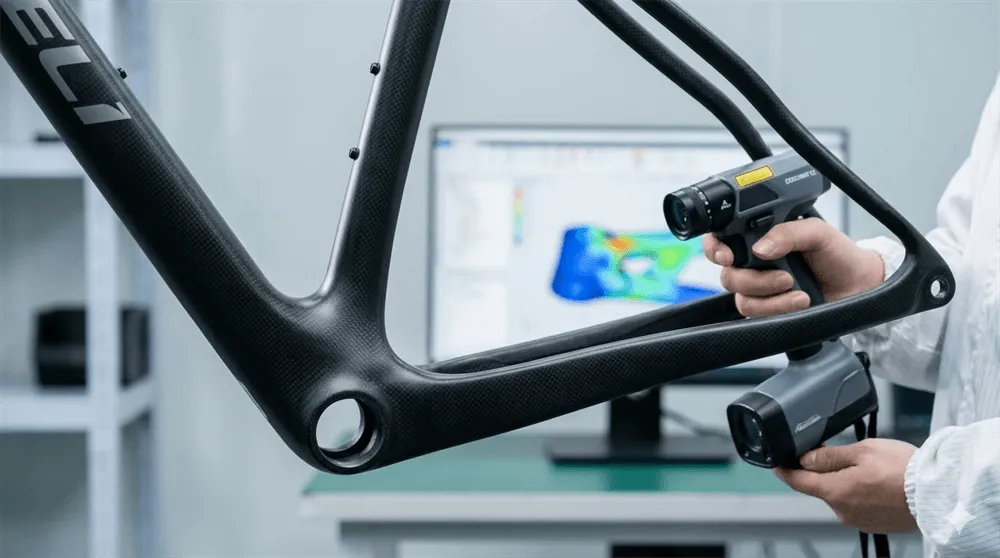
Reliable manufacturers will perform complete fatigue testing, impact testing, and tensile strength testing to ensure that each batch of frames meets European and American market safety standards (such as EN 14781 or ISO4210). At the same time, the quality control (QC) process must cover raw material inspection, random inspection during the lamination process, and finished product retesting to ensure consistency and stability. For wholesalers, this test data is the core basis for judging whether a supplier is worthy of long-term cooperation.
3.3 Sample Evaluation Strategy
Before mass production, rigorous evaluation of samples is essential. Evaluation methods include measuring frame weight, checking delamination, surface treatment quality, and conducting functional tests. When communicating with suppliers, the sample evaluation standards and modification requirements should be clearly defined, including material replacement, layup adjustments, or surface treatment optimization, to ensure that mass-produced frames are consistent with the samples and reduce rework and after-sales risks.
After-Sales and Service Support
When choosing a reliable Carbon Bike Frame Manufacturer, in addition to craftsmanship and quality, after-sales and service support are also core indicators that B2B customers care about most. A comprehensive after-sales system not only guarantees risk control during product transportation, storage, and use, but also directly affects the stability of long-term cooperation and the controllability of the supply chain. Understanding the factory’s capabilities in warranty policies, return and exchange procedures, technical support, and customization capabilities is crucial to ensuring continuous brand supply and customer satisfaction.
4.1 Warranty Policy and After-Sales Process
High-standard warranty policies and after-sales services help wholesalers effectively mitigate losses caused by product defects. Reliable manufacturers usually clearly define return and exchange rules, warranty periods, and coverage, while also establishing a rapid response mechanism to address potential quality issues in bulk orders. In long-term cooperation, a clear after-sales process is also an important part of risk control, ensuring that the brand can obtain stable and reliable service support even in large-scale purchases or international transportation.
4.2 Technical Support and Customization Capabilities
For B2B customers, the manufacturer’s technical support and customization services are important criteria for measuring the value of long-term cooperation. An experienced team of engineers can assist brands in new project development, drawing optimization, and performance testing, ensuring that customized OEM/ODM carbon bike frames meet the performance requirements of the target market. At the same time, rapid technical response and flexible R&D cooperation capabilities help shorten product development cycles and improve the brand’s competitiveness in the North American and European markets.
Price and Cost-Effectiveness Analysis
When choosing a reliable carbon bike frame manufacturer, price is not the only consideration; understanding the cost structure and the long-term cost-effectiveness of the partnership is crucial. Wholesalers and brands need to analyze factors such as raw materials, production processes, and transportation to assess the reasonableness of the quoted price and avoid “low-price traps.” Understanding the difference between long-term partnership costs and one-time purchase prices will help in making the best procurement decisions.
5.1 Cost Structure Analysis
Frame costs mainly include raw materials (high-modulus carbon fiber fabric, resin, auxiliary materials), labor, processing techniques (layup, curing, mold usage), surface treatment, and transportation. In the European and American markets, transportation and tariffs significantly impact the final price. Focusing on cost transparency allows you to determine whether the supplier has stable production capabilities and provides accurate pricing.
5.2 Cost-Effectiveness vs. Quality
Low price does not equal high cost-effectiveness; “low-price traps” often hide compromises in materials or lax quality control. B2B customers should weigh the trade-off between long-term partnership costs and one-time purchase prices. High-quality manufacturers provide reliable quality control processes, consistent layup techniques, and traceable sample testing records, ensuring stable supply and product consistency – this is the true advantage of cost-effectiveness.
On-Site Inspection and Factory Audit
For wholesalers and brands, it’s difficult to fully assess the production capabilities and quality level of a Carbon Bike Frame Manufacturer solely through online information. Therefore, arranging an on-site inspection becomes a crucial step in determining the factory’s reliability. Through on-site visits, you can gain a direct understanding of the production process, the modernity of the equipment, and the team’s operational standards, providing a reliable basis for subsequent bulk purchases or custom carbon fiber frame orders.
6.1:Visiting the Production Workshop
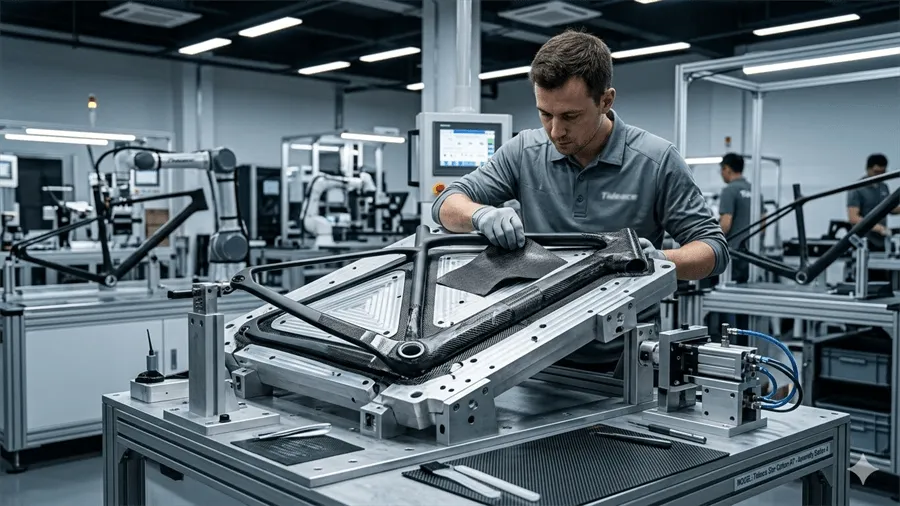
When visiting the production workshop, focus on the assembly line process, equipment automation and precision, and material storage and handling procedures. Wholesalers typically look for whether the factory has a full carbon layup process, curing equipment, and CNC molding capabilities, as these directly affect the consistency and reliability of the frame.
6.2:On-Site Inspection of Key Processes
Key processes include layup, curing, molding, and surface treatment. Each step affects the strength and lightweight properties of the final product. Checking the factory’s quality control (QC) process and sampling records can confirm whether there are batch variations or potential defect risks. Furthermore, reviewing prototype testing records can help wholesalers assess the manufacturer’s reliability in terms of durability and performance.
Summary: Key Considerations for Choosing a Reliable Carbon Bike Frame Manufacturer
Choosing the right carbon bike frame manufacturer is crucial not only for product quality but also for the long-term stability of your brand’s supply chain and market competitiveness. Wholesalers should focus on the factory’s certifications, the maturity of its manufacturing processes, sample evaluation records, and after-sales service system. A thorough understanding of the full carbon production process, quality control procedures, and prototype testing can effectively reduce the risks of bulk purchasing and ensure that each batch of frames meets the requirements for lightweight design, durability, and consistency.
At the same time, OEM/ODM customization capabilities, production flexibility, and delivery time management are also important indicators of a factory’s reliability. Overall, establishing a long-term partnership with a technologically mature and reputable manufacturer is more beneficial for brand interests and supply chain stability than simply pursuing low-cost single purchases, leading to sustained growth and market trust for wholesalers.
Recommended Chinese manufacturers of high-quality carbon fiber bicycle frames:
Shenzhen Haideli Bikes – Specializing in carbon fiber frames and high-performance components, with a rigorous drop/fatigue testing system.
Xiamen LightCarbon – Covering a full range of carbon fiber products for MTB, Road, and E-Bikes;
ICAN – Professionally providing various full carbon frames and wheelsets, supporting OEM/ODM customization options, and having passed SGS/EN quality testing standards and exporting to global markets;
DengFu – Possessing stable production capacity and a variety of carbon fiber frame models, suitable for wholesalers and brand building.