Skip to content


Carbon bike frame Non-Destructive Detection is now a critical phase in precision manufacturing. Utilizing Non-Destructive Testing (NDT)—including X-ray Radiography, Industrial X-ray inspection, and Infrared Thermography—ensures absolute transparency during Carbon bicycle frame internal inspection. We prioritize Carbon frame X-ray analysis to identify Hidden defect like Air bubbles / voids, Delamination, and Cracks, guaranteeing Frame safety testing meets global standards. Facilities adopting Radiographic testing (RT) see a 30% boost in defect detection, anchoring the trust of premium global brands.
Defining Carbon Bike Frame Non-Destructive Detection
Carbon bike frame Non-Destructive Detection is a critical Non-Destructive Testing (NDT) protocol. Using X-ray Radiography, X-ray imaging, and Industrial X-ray inspection, we perform Carbon bicycle frame internal inspection to identify anomalies without damaging the chassis. This Non-Destructive Evaluation enables precise Hidden defect analysis, ensuring early risk mitigation and superior batch consistency.
1.1: NDT and NDE Integration
Combining Non-Destructive Testing (NDT) and Non-Destructive Evaluation is essential. Through Radiographic testing (RT), Carbon frame X-ray analysis, and Infrared Thermography, we isolate Air bubbles / voids, Delamination, and Cracks for data-driven quality control.
1.2: Internal Inspection and Frame Safety
Carbon bicycle frame internal inspection is vital for Frame safety testing. Internal issues like Resin rich / resin starved areas or Internal damage are invisible to the eye, requiring X-ray inspection and Advanced inspection technology for validation.
1.3: Targets: Internal Structure and Defect Detection
Internal structure inspection validates overall integrity, while Internal defect detection focuses on micro-anomalies. Systematic Carbon frame radiographic inspection ensures every mass-produced frame meets elite safety and performance targets.
Structural Transparency: Hidden Defect Analysis in Carbon Frames
In Carbon bike frame Non-Destructive Detection, Internal defect detection is the anchor of quality control. Utilizing Carbon frame X-ray analysis and X-ray inspection, we expose anomalies invisible to the eye. Deficiencies like Air bubbles / voids or Delamination compromise Frame safety testing and stability; thus, they must be eliminated during Carbon bicycle frame internal inspection to secure long-term reliability.
2.1: Air Bubbles and Voids: Identifying Structural Voids
These Structural voids often stem from molding pressure variance. By employing X-ray imaging and Radiographic testing (RT), we isolate these gaps before they trigger fatigue-life degradation.
2.2: Delamination: Interlaminar Failure Detection
Delamination signals a failure in ply bonding, often caused by impact or process instability. Utilizing Industrial X-ray inspection—a prerequisite in Advanced inspection technology—allows for the surgical identification of interlaminar separation.
2.3: Cracks and Internal Damage: High-Risk Latent Defects
Cracks typically hide in stress-concentrated zones as catastrophic Hidden defect. Systematic Carbon frame radiographic inspection enables us to intercept micro-cracks before they evolve into structural failures.
2.4: Wrinkles and Resin Distribution (Resin Rich / Resin Starved)
Ply Wrinkles and Resin rich / resin starved areas distort mechanical performance. Through Carbon frame X-ray analysis and X-ray imaging, we execute granular assessments of material density, ensuring the chassis hits its rigidity targets.
Essential Detection: X-ray and NDT Technologies
In Carbon bike frame Non-Destructive Detection, X-ray Radiography and Non-Destructive Testing (NDT) are central. Through Carbon bicycle frame internal inspection and Industrial X-ray inspection, we visualize internal structures to identify Hidden defect like Air bubbles / voids, Delamination, and Cracks. This ensures reliable Frame safety testing and batch uniformity.
3.1: X-ray Radiography and Real-time Imaging
X-ray imaging provides high-penetration auditing, making it a cornerstone of Carbon frame X-ray analysis. It quickly identifies Internal damage and structural anomalies without damaging the composite.
3.2: Industrial X-ray Inspection and Mass Production QC
Industrial X-ray inspection executes systemic Internal defect detection during production. This ensures all shipments hit the aggressive Composite material inspection targets expected by global brands.
3.3: Radiographic Testing (RT) for Structural Integrity
Radiographic testing (RT) isolates critical defects like Structural voids and Resin rich / resin starved areas. It is a vital phase for securing high-end frameset performance and durability.
3.4: Infrared Thermography and Advanced Inspection Systems
Infrared Thermography flags subsurface flaws via thermal response. Combined with Advanced inspection technology, it boosts detection efficiency within the Carbon bike frame Non-Destructive Detection workflow.
Execution: The Carbon Frame Radiographic Inspection Workflow
In Carbon bike frame Non-Destructive Detection, radiographic inspection is the ultimate anchor for structural integrity. Utilizing X-ray Radiography and Industrial X-ray inspection, we execute a full-phase Carbon bicycle frame internal inspection. This protocol is designed to neutralize Hidden defect analysis risks—such as Air bubbles / voids, Delamination, and Cracks—while anchoring Frame safety testing and batch consistency.
4.1: The Tech: How is a Carbon Bike Frame X-rayed?
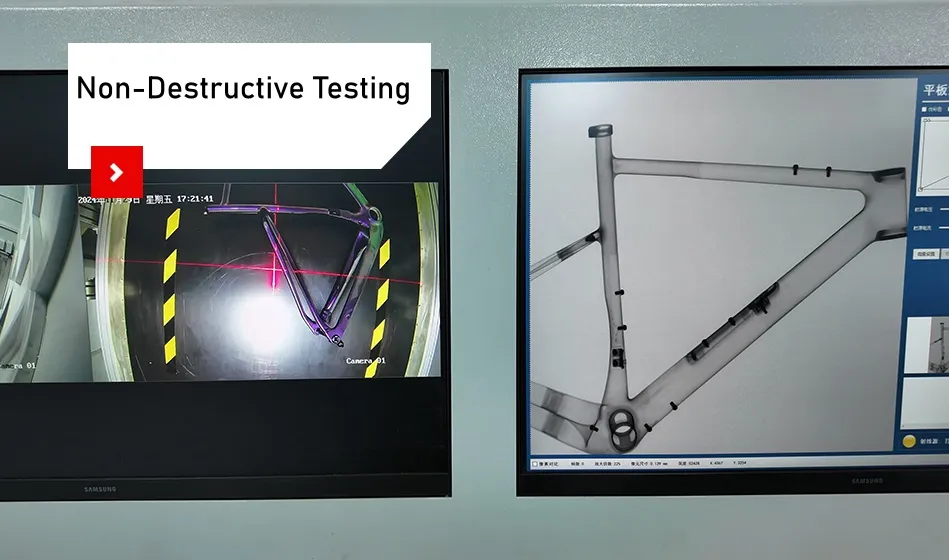
Frames enter a Radiographic testing (RT) chamber for multi-angle X-ray imaging. X-rays penetrate the Composite material inspection zones, creating density-based imagery to identify anomalies. This Carbon frame X-ray analysis validates Carbon fiber layup uniformity and detects Structural voids or Internal damage that remain invisible to the naked eye.
4.2: Industrial X-ray Inspection Parameters
The workflow begins with precision fixturing and calibration, followed by optimizing voltage for Industrial X-ray inspection. Multi-angle X-ray inspection then maps high-stress areas like the headtube, BB, and stays. As a Non-destructive testing (NDT) method, it provides absolute validation without compromising the chassis, making it ideal for high-volume QC.
4.3: Image Analytics and Defect Mitigation
Post-scan, specialized software isolates anomalies within the Carbon frame radiographic inspection data. We specifically target Air bubbles / voids, Delamination, Cracks, and Resin rich / resin starved areas. Using grayscale variance, engineers perform Hidden defect analysis to ensure every unit survives Frame safety testing. For global brands, this transparency is the hallmark of a Tier-1 supplier.
Execution: Why X-ray Inspection is Non-Negotiable
Visual audits cannot identify internal structural deviations. By integrating Carbon bike frame Non-Destructive Detection with X-ray Radiography and Industrial X-ray inspection, we achieve total Carbon bicycle frame internal inspection. This transparency isolates safety risks before they reach the market, anchoring batch consistency and neutralizing post-sale liabilities.
5.1: Frame Safety Testing and Quality Loops
Safety testing is a mandatory validation phase. Through Radiographic testing (RT) and Non-Destructive Testing (NDT), we execute a systemic Internal structure inspection. This allows for the precise detection of anomalies in Carbon frame X-ray analysis, such as Resin rich / resin starved zones, ensuring every chassis hits its performance benchmark.
5.2: Capability: Can X-ray Detect Carbon Fiber Defects?
Absolutely. X-ray imaging pierces the composite to isolate Hidden defect analysis triggers: Air bubbles / voids, Delamination, Cracks, and Structural voids. Unlike visual checks, X-ray inspection enables deep Internal defect detection, making Carbon frame radiographic inspection essential for high-performance frameset validation.
5.3: Mitigating Hidden Defects and Volume Risks
In mass production, Hidden defect risks trigger catastrophic recalls. Utilizing Advanced inspection technology and Industrial X-ray inspection facilitates early-stage screening to prevent systemic failure. This proactive Carbon bike frame Non-Destructive Detection methodology is the bedrock of supply chain stability and brand integrity.
X-ray vs. Visual Inspection: Defining the Difference
X-ray inspection and visual audits serve different depths. X-ray is a critical Non-Destructive Testing (NDT) method for Carbon bicycle frame internal inspection, while visual checks manage surface quality. Combining both ensures batch reliability and reduces safety risks.
6.1: X-ray imaging vs. Visual Audits
X-ray inspection (including Industrial X-ray inspection and RT) enables Carbon frame X-ray analysis to find Air bubbles / voids, Delamination, and Cracks. Visual checks focus on paint and texture, lacking the capability for Hidden defect analysis. Premium clients now demand a carbon frame X-ray inspection report to guarantee structural safety.
6.2: Internal Structure vs. Cosmetic Quality
Internal structure inspection identifies resin rich / resin starved areas, wrinkles in carbon fiber, and structural voids that impair frame safety testing. Visual audits alone cannot fulfill a complete Carbon bike frame quality control process explained. Using Advanced inspection technology like X-ray Radiography is the only way to minimize production risks.
Production Protocol: The Carbon Bike Frame Quality Control Process
Batch reliability stems from systematic Carbon bike frame Non-Destructive Detection. From Composite material inspection to post-molding Internal structure inspection, X-ray validation, and stress testing, every stage governs Frame safety testing targets and structural consistency.
7.1: Composite Material Inspection and Raw Audits
We focus on Composite material inspection to verify ply orientation, moisture content, and Resin rich / resin starved areas. This proactive vetting neutralizes Structural voids or Internal damage risks, anchoring the balance between weight-shaving and rigidity.
7.2: Internal Structure Inspection during Molding
During curing, Internal structure inspection monitors compaction and bonding to isolate Wrinkles or Delamination. This critical Carbon bicycle frame internal inspection phase determines the frame’s fatigue life and real-world safety margins.
7.3: Syncing X-ray and Structural Stress Testing
Utilizing Industrial X-ray inspection and Radiographic testing (RT) for Carbon frame X-ray analysis allows us to identify Air bubbles / voids or Cracks—the catastrophic Hidden defect. This integrates into a complete Frame safety testing ecosystem.
7.4: How Manufacturers Validate Strength
Strength validation includes stiffness, fatigue cycling, and destructive sampling, cross-referenced with Non-Destructive Evaluation data. The “X-ray imaging + mechanical loading” methodology is now the global benchmark for elite frameset quality control.
Is X-ray Testing Necessary for Your Frame Production?
X-ray inspection depends on your market positioning. While Carbon bike frame Non-Destructive Detection is standard for premium builds, base models often trade audit depth for cost.
8.1: X-ray Radiography and Internal Inspection
As an Advanced inspection technology, X-ray Radiography provides the only path to surgical Carbon bicycle frame internal inspection. For high-stress MTB or Road frames, Industrial X-ray inspection identifies Delamination and Voids, securing batch reliability and reducing warranty claims.
8.2: Tiered Standards for Carbon Frames
High-end projects must supplement Visual inspection with Radiographic testing (RT) and Infrared Thermography. Internal structure inspection for Cracks and resin variance is vital as frames get lighter and engineering tolerances shrink.
8.3: Quality Standards for Global Brands
Top-tier manufacturers utilize a full Non-destructive testing (NDT) workflow, from Composite material inspection to Carbon frame X-ray analysis. Traceable data and consistency reports are now the non-negotiable benchmarks for securing OEM contracts
FAQ: Strategic Insights into Carbon Bike Frame Non-Destructive Detection
Focusing on Carbon bike frame Non-Destructive Detection, these insights address the critical quality and logic concerns of manufacturers and procurement leads. Covering X-ray inspection, Non-Destructive Testing (NDT), and structural validation, this FAQ helps define a supplier’s auditing depth and batch reliability.
9.1: How is a carbon bike frame X-rayed?
We utilize Industrial X-ray inspection to capture full-frame X-ray imaging. This raw data undergoes Carbon frame X-ray analysis to achieve surgical Carbon bicycle frame internal inspection and precise anomaly mapping.
9.2: Why is X-ray testing critical for carbon frames?
Visual checks cannot identify latent Hidden defect like Delamination or Voids. X-ray is the definitive anchor for Frame safety testing and ensuring that mass-produced units maintain the same structural integrity as the prototype.
9.3: Can X-ray effectively detect all carbon fiber defects?
Through Radiographic testing (RT), we isolate Air bubbles, Cracks, resin variance, and Internal damage. However, high-level Defect interpretation by expert technicians is required to distinguish structural risks from harmless imaging artifacts.
9.4: X-ray inspection vs. visual inspection: What’s the difference?
Visual inspection handles cosmetics and finish. Conversely, Carbon frame radiographic inspection enables Internal structure inspection. In a professional QC workflow, these methods complement each other to bridge the gap between aesthetics and safety.
9.5: How do manufacturers validate carbon frame strength?
Reliability is forged by pairing Non-Destructive Testing (NDT) with destructive protocols (e.g., Fatigue and Impact testing). This dual-layer approach ensures Composite material inspection aligns with real-world structural durability.
9.6: Is X-ray testing a requirement for modern frame production?
For premium Carbon frame builds and elite OEM partnerships, X-ray inspection is the industry standard for Advanced inspection technology. It is the most effective tool for mitigating volume-production risks and neutralizing long-term warranty costs.
Conclusion: The Value of Non-Destructive Detection
In the Carbon bike frame Non-Destructive Detection (NDT) ecosystem, advanced auditing is the definitive anchor for structural stability. Protocols like X-ray inspection and Internal structure inspection do more than ensure performance—they mitigate production risks and preserve brand integrity at the source.
10.1: Securing Integrity through NDT Protocols
Utilizing X-ray Radiography and Radiographic testing (RT) allows for the surgical identification of voids, Delamination, and Cracks. These latent Hidden defect are neutralized via rigorous Carbon bicycle frame internal inspection and Frame safety testing, guaranteeing batch-wide consistency and long-term fatigue resistance.
10.2: Strategic Implications for B2B Brands
Suppliers equipped with Industrial X-ray inspection are uniquely positioned to manage high-stakes OEM contracts. This capability satisfies aggressive quality control and risk reduction mandates, effectively eliminating warranty liabilities. For Tier-1 carbon bike frame projects, radiographic transparency is the ultimate benchmark for partnership.