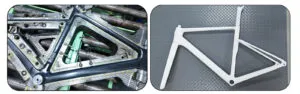
Carbon Bike Frame Test
Testing Before Production
- Strength testing
- Fatigue testing
- Impact testing
Carbon Bike Frame Testing: Why ISO 4210 is Only the Baseline for Safety
When riders discuss carbon fiber, the “elephant in the room” is always: “Is it actually strong enough for real-world carnage?”
It’s a valid concern. While carbon fiber offers a world-class strength-to-weight ratio, its structural integrity isn’t accidental—it’s engineered. Unlike aluminum or steel, carbon’s performance is dictated by layup precision, resin chemistry, and, most crucially, destructive validation.
In this guide, we’ll strip away the marketing fluff and look at how professional Carbon Frame Manufacturers push frames to the breaking point to ensure rider safety.
What Tests Define a High-Quality Carbon Bike Frame? (Quick Summary)
A pro-grade carbon frame must survive three brutal validation stages before it ever hits the trail:
- Structural Stiffness Testing – Validates power transfer and head-tube precision.
- Extended Fatigue Testing – Simulates 5–10 years of aggressive riding in a compressed lab cycle.
- Real-World Impact Testing – Replicates rock strikes, drop-to-flat scenarios, and front-end crashes.
The Industry Secret: While most factories chase “ISO Compliance,” elite manufacturers treat ISO 4210 as a starting point, not the finish line.
The "Fragility" Myth: Carbon vs. Aluminum Failure
Let’s settle the debate. Carbon is often perceived as fragile because it doesn’t “dent” like metal—it either holds or it fails. However, a masterfully engineered carbon layup absorbs and dissipates energy across fiber plies far more effectively than thin-walled alloy.
| Feature | Aluminum Frames | High-End Carbon Frames |
| Failure Mode | Accumulates fatigue; unpredictable cracking. | Engineered stress distribution across layers. |
| Stiffness Retention | Degrades over thousands of miles. | Maintains “snap” and rigidity for its lifespan. |
| Impact Recovery | Permanent deformation (dents). | High elastic threshold; absorbs energy via resin/fiber matrix. |
Inside the haidelibikes factory: How We Validate Carbon Frame Quality
At Haidelibikes, testing isn’t a post-production checkbox—it’s an iterative engineering tool. Here is the technical breakdown of our protocol:
1. Impact, Dropping and Destructive Testing
We don’t just simulate smooth trails; we engineer for the worst-case scenario. Our destructive protocols push every carbon bike frame to its physical breaking point to establish a true structural safety ceiling.
- Vertical Drop-to-Flat Validation: Every carbon frame is subjected to drop heights well beyond ISO 4210 norms. This ensures the carbon fiber layup can absorb the massive energy of a “cased” jump or a heavy landing without internal delamination or cracking.
- Front-End Collision Simulation: We replicate high-velocity frontal impacts to stress-test the head-tube and down-tube junctions of the carbon bicycle frame. This ensures the structure dissipates force effectively, preventing catastrophic snapping during unexpected trail-side carnage.
- The Goal: Achieving zero structural compromise under peak impact loads that exceed the most violent real-world crash scenarios by 200%. We build each carbon bike frame to act as a survival cell for the rider.
Front Drop Test
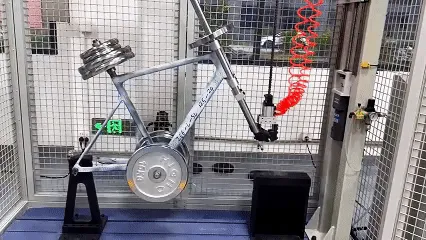
Carbon bike frame drop tests reveal hidden damage from impacts, showing how minor hits can cause internal cracks. These tests ensure frame strength, safety, and real-world reliability.
Impact Test
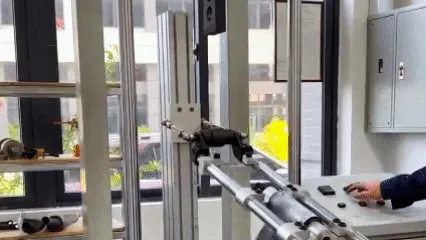
Carbon fiber bike frame impact tests simulate crashes, using weight drops to detect cracks and hidden damage, ensuring durability and safety for every ride.
Rear Drop Test
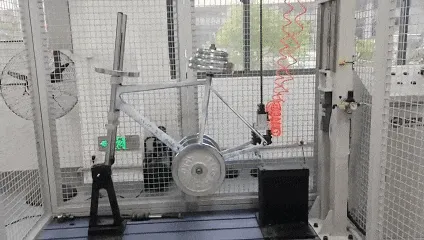
Rear drop test evaluates the strength of each carbon bicycle frame under extreme conditions. Designed to withstand heavy impacts, it ensures your frame’s durability and safety during real-world rides.
Front Dropping Test
Front drop test simulates sudden falls, ensuring the carbon bicycle frame’s ability to absorb impact. This rigorous test guarantees your frame’s strength, safety, and performance in tough conditions.
2. Fatigue and Stiffness Testing (Long-Term Performance Retention)
ISO 4210 requires 100,000 cycles. We double it to ensure your carbon bike frame never loses its “snap.”
- Dynamic Stiffness Mapping: We don’t just measure the carbon bicycle frame when it’s new. We track bottom bracket stiffness and torsional rigidity throughout the entire fatigue cycle. This ensures the carbon fiber layup maintains its reactive power transfer and steering precision after years of abuse.
- 200,000 Cycle Endurance Protocol: We subject the carbon mountain bike frame to alternating stress directions for weeks. After 200,000 cycles, we use ultrasonic scanning to detect internal delamination or micro-cracks in the carbon frame production that the naked eye would miss.
- The Goal: Ensuring that even after 5-10 years of simulated riding, the carbon bike frame retains 99% of its original structural integrity and pedaling efficiency. If there’s even a 1% drop in stiffness, the design goes back to the drawing board.
Horizontal Fatigue Test
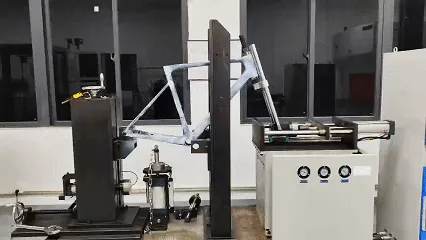
Our carbon fiber bike frame passes a rigorous Horizontal Fatigue Test, enduring 100,000+ cycles of fore/aft loads to ensure durability and meet top safety standards.
Pedaling Fatigue Test

Pedaling fatigue tests simulate years of riding by applying repeated forces, checking for micro-cracks or stiffness loss, and ensuring compliance with ISO4210, EN14781, EN14766, and EN14764 standards.
Headtube Stiffness Test
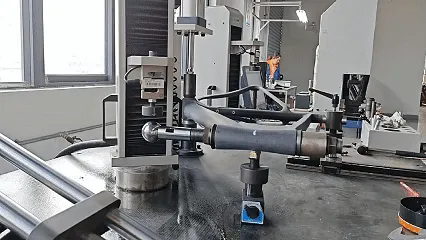
Rear drop test evaluates the strength of each carbon bicycle frame under extreme conditions. Designed to withstand heavy impacts, it ensures your frame’s durability and safety during real-world rides.
Bottom Bracket Stiffness Test
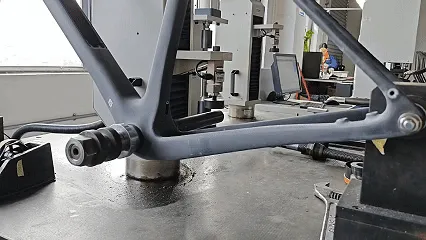
Front drop test simulates sudden falls, ensuring the carbon bicycle frame’s ability to absorb impact. This rigorous test guarantees your frame’s strength, safety, and performance in tough conditions.
Rear Triangle Dual-Sided Stiffness Test
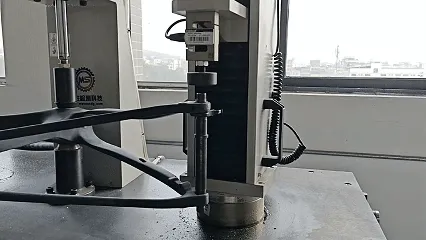
Dual-sided stiffness test measures the bike frame’s rear triangle for optimal power transfer and handling. This test ensures your frame’s rigidity, strength, and performance under load.
Rear Triangle Single-Sided Stiffness Test
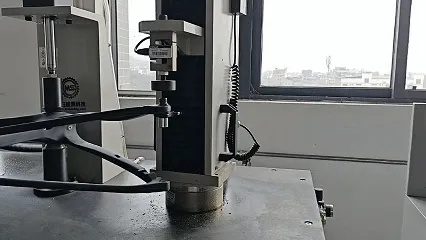
Single-sided stiffness test ensures that every bike frame delivers optimal power transfer and stability. Designed to withstand real-world forces, it guarantees peak performance in every ride.
3. X-Ray Inspection & Vibration Damping (Internal Integrity & Ride Quality)
We go beyond visual checks, scanning the carbon bike frame’s internal DNA to ensure structural perfection and active vibration management.
- Precision X-Ray Internal Audits: Every high-performance carbon mountain bike frame undergoes non-destructive X-ray scanning to eliminate hidden voids or resin pooling. This ensures the carbon fiber layup is fully compacted, removing structural risks before the carbon bicycle frame leaves the mold.
- Sub-Surface Ply Verification: We verify that internal fiber orientation matches our engineering specs, particularly at high-load junctions. This high-level carbon frame production oversight guarantees a flawless internal architecture.
- Harmonic Vibration Testing: To keep riders fresh, we analyze the carbon bike frame’s natural damping. We tune the carbon fiber layup to filter out technical “trail buzz” while preserving the explosive lateral stiffness expected of a world-class carbon mountain bike frame.
- The Goal: 100% internal consistency. We balance vertical compliance with lateral stiffness, ensuring the carbon bike frame delivers both brute strength and refined comfort.3. X-Ray & Vibration Damping: The “Invisible” Quality Standard.
X-Ray Inspection
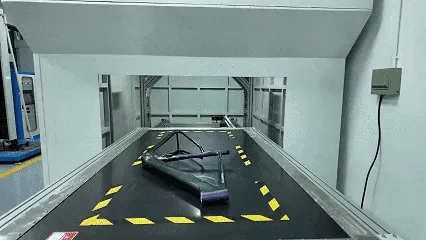
X-ray inspection technology thoroughly examines each bike frame for internal defects. By detecting hidden cracks and imperfections, it ensures your frame’s strength, safety, and durability.
Vibration Testing
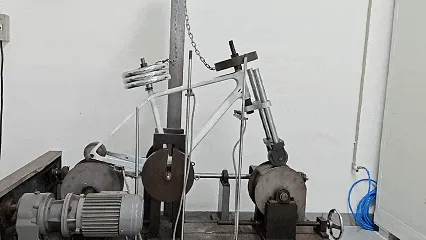
Ensure durability and performance with advanced bicycle frame vibration testing. Simulating real-world conditions, we guarantee frames that withstand vibrations, delivering smoother, safer rides.
Carbon Bike Frame Testing: Frequently Asked Questions (FAQ)
Q: Why is in-house testing capability non-negotiable when choosing a Carbon Bike Frame Manufacturer? A: A professional Carbon Bike Frame Manufacturer must operate its own laboratory. It’s about more than just checking a box; it’s about having the data to relentlessly refine the carbon fiber layup schedule during the Custom Carbon Bike Frame development phase. Factories with internal labs can pivot faster to market shifts—like the rise of 32er frames—while ensuring every production batch hits industrial-grade structural integrity standards.
Q: Beyond ISO 4210, what additional validations should a top-tier OEM Supplier provide? A: ISO 4210 is merely the baseline for market entry. As a reliable OEM Supplier, we double down with Fatigue Testing (200,000 cycles), Impact Testing (exceeding standards by 20%), and X-Ray Inspection for internal flaws. these “beyond-standard” protocols ensure that every carbon bicycle frame in a high-volume order performs consistently under professional race conditions.
Q: Is testing integrated into the Custom Carbon Bike Frame development workflow? A: Absolutely. At Haidelibikes, every Custom Carbon Bike Frame project follows a rigorous path from Finite Element Analysis (FEA) to physical Sample Validation. We conduct Destructive Testing on project-specific geometries to guarantee that the stiffness-to-weight ratio and impact resistance meet your brand’s targets before mass production ever begins.
Q: How can I tell if a Carbon Frame Production facility’s QC is actually reliable? A: The differentiator is how they handle “invisible” flaws. Leading carbon frame production lines utilize Ultrasonic Scanning or X-Ray Inspection to detect internal voids or layup shifts that the naked eye will never see. If a supplier cannot explain their internal consistency management in detail, it’s a major red flag for quality drift.
Q: Do stricter testing standards significantly drive up the cost of a Carbon Mountain Bike Frame? A: While rigorous testing adds upfront R&D costs, it pays for itself by slashing warranty claims and protecting your brand’s reputation. As expert manufacturers, we optimize the carbon fiber layup to eliminate structural weak points before production, ensuring our carbon mountain bike frames deliver elite performance with the best long-term ROI in the industry.
Let’s Build: Partner With a Veteran Carbon Frame Manufacturer
Top-tier frames aren’t just built; they are engineered into existence. As a veteran Carbon Fiber Bicycle Manufacturer, we don’t hide behind minimum ISO standards. We offer a “test-to-fail” engineering DNA that ensures your brand’s reputation remains indestructible on the trail.
Our OEM Supplier ecosystem bridges the gap between high-concept Custom Carbon Bike Frame design and rock-solid carbon frame production. Whether it’s surviving our brutal 200,000-cycle fatigue protocol or optimizing a complex carbon fiber layup for the ultimate stiffness-to-weight ratio, we deliver podium-ready chassis without the technical headaches.
Stop settling for generic factory claims. Contact our engineering team to audit our real-world test data or request a production sample.
Explore Our Latest Blogs